Greyhound racing survey guidance
10 minutes to make your voice heard for dogs
The Royal Veterinary College (RVC) is conducting research into public knowledge and attitudes towards greyhound racing in England. The survey asks about people’s understanding of the industry, their views on greyhound welfare and racing, and their experiences with dogs and greyhound racing.
The more people who add their voices, the better! This is an opportunity to make sure the reality and cruelty of the industry is represented in research on public attitudes towards the industry.
This survey is anonymous and open to those aged 18+ who currently live in England.
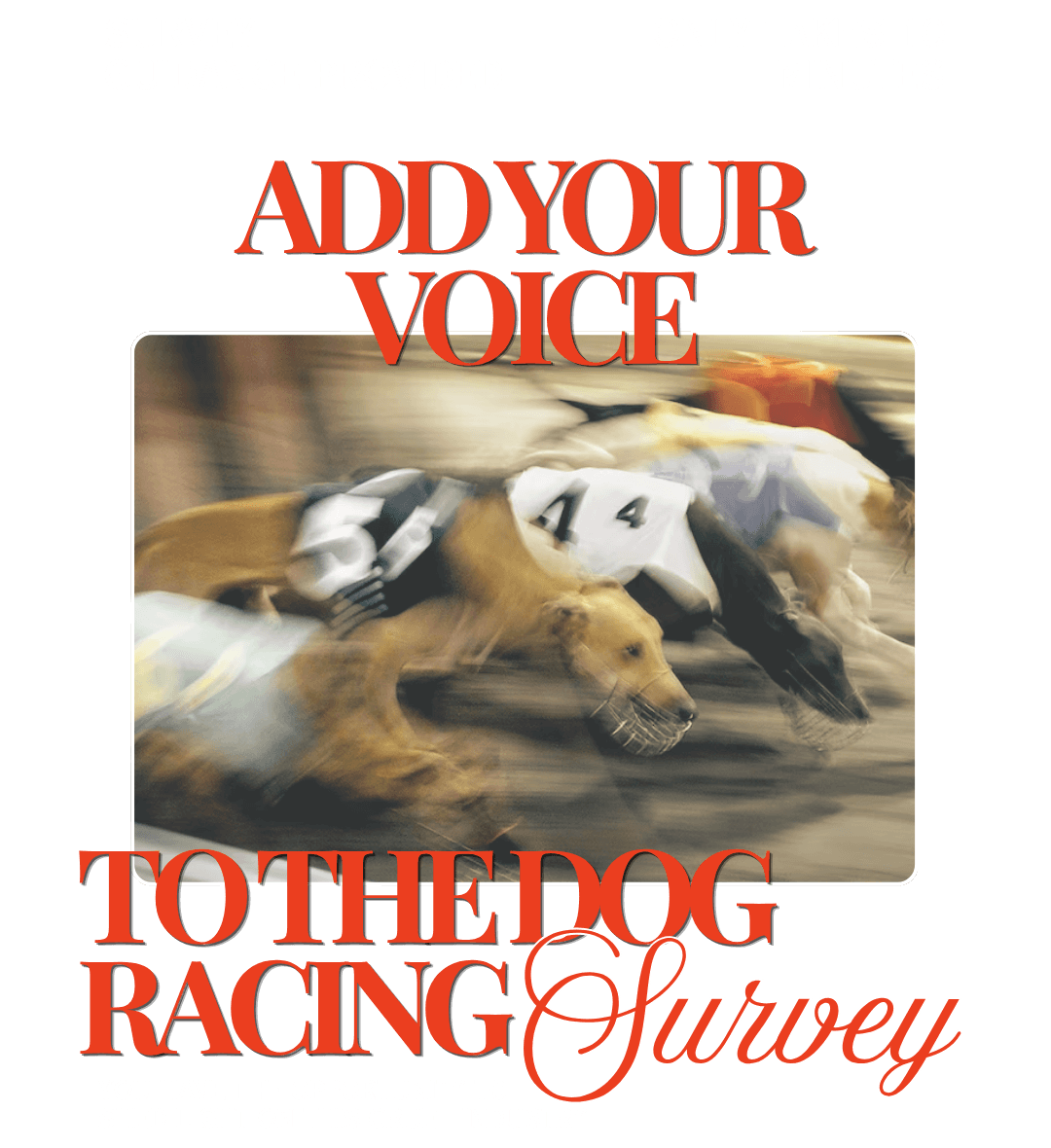
Shut Down Romford survey guidance
We’ve gone through the survey question by question and provided our recommended responses to make it as simple as possible for you to advocate for greyhounds!
- For questions about your personal experiences, demographics or circumstances, please answer honestly.
- For questions about greyhound racing and your attitudes towards it, we’ve provided recommendations, but please answer as you find fit.
- For any questions that require a short-answer text response, we’ve provided some general talking points. Please adapt it into your own unique response!
Click on the question to reveal the answer guidance.
SECTION 1: Your involvement and knowledge
Answer as it applies to you.
Choose the option that honestly reflects your own level of knowledge.
Answer each one honestly.
Do not select answers based on what you think the researchers want to hear. These questions are measuring participants’ actual experience and involvement.
NO
Greyhounds are sentient animals, not entertainment. Their lives should not be exploited for human profit or ‘pleasure’.
NO
Gambling on greyhounds makes their bodies and lives part of a commercial entertainment system that exploits, injures, traumatises, and kills them.
Animals are individuals, not products nor a money-making wager on a Ladbrokes screen.
NO
Greyhounds don’t choose to race. Calling something a sport does not change the fact that humans are imposing the activity on animals for entertainment and profit.
Answer as it applies to you.
This is asking about your actual betting behaviour, not your opinion of gambling.
SECTION 2: Attitudes towards greyhound racing
| Statement | Recommended answer |
|---|---|
| I believe racing provides greyhounds with a good life | Strongly disagree |
| I believe greyhound racing endangers greyhound well-being during racing | Strongly agree |
| I believe greyhound racing leads to the on-track death of greyhounds | Strongly agree |
| I believe the racing regulations protect the wellbeing of greyhounds | Strongly disagree |
| I believe greyhound racing contributes to general human well-being (relaxation, social opportunities) | Strongly disagree |
| I believe greyhound racing is well regulated in England | Strongly disagree |
| I believe racing greyhounds have poor living conditions in their first year of life before race training starts | Strongly agree |
| I believe greyhound racing provides jobs for England | Strongly disagree |
| I believe greyhound racing contributes to the death of greyhounds due to behavioural issues | Strongly agree |
| I believe racing greyhounds have poor living conditions in training kennels | Strongly agree |
| I believe the greyhound racing industry does a good job rehoming greyhounds after racing | Strongly disagree |
| I believe greyhound racing brings the community together | Strongly disagree |
| I believe greyhound racing creates a poor international reputation for England | Strongly agree |
| I believe greyhound racing endangers greyhound well-being when not racing | Strongly agree |
| I believe greyhound racing supports English cultural values (traditions) | Strongly disagree |
| I believe racing greyhounds have poor living conditions when they are bred | Strongly agree |
| I believe greyhounds enjoy racing | Strongly disagree |
| I believe greyhound racing preserves the greyhound breed | Strongly disagree |
| I believe race organisers prioritise greyhound well-being | Strongly disagree |
| I believe greyhound racing contributes to the use of illegal or banned substances | Strongly agree |
| I believe greyhound racing contributes to dog overpopulation | Strongly agree |
| I believe greyhound racing normalises exploitation of animals for entertainment | Strongly agree |
| I believe greyhound racing provides economic opportunities for England | Strongly disagree |
| I believe greyhound racing leads to greyhound injuries | Strongly agree |
| I believe greyhound racing is good entertainment | Strongly disagree |
| I believe greyhound racing contributes to the death of greyhounds due to health issues | Strongly agree |
| I believe greyhound racing supports gambling in society | Strongly agree |
| I believe greyhounds can be difficult to rehome due to early life experiences | Strongly agree |
A note on some of these answers
Human enjoyment is not a justification for animal exploitation. Any human ‘benefits’ from greyhound racing, such as entertainment, social opportunities, or gambling profit, are at the expense of animals. We do not consider that a legitimate form of human wellbeing.
Likewise, the fact that many rescued greyhounds become wonderful, loving companions does not mean they never face barriers when leaving racing. Some may require additional support due to the physical and behavioural experiences imposed on them by the industry. Those challenges are not a failing of greyhounds but are instead representative of the industry itself.
And where the industry generates employment or economic activity, that does not make the exploitation of greyhounds morally acceptable. Economic activity is not a justification for animal exploitation.
MAINLY NEGATIVE
Human entertainment, gambling, social opportunities and economic activity cannot outweigh the suffering, injuries, deaths and exploitation experienced by greyhounds.
We don’t believe the exploitation of animals becomes a legitimate “positive” simply because humans enjoy it.
YES, I WOULD STRONGLY SUPPORT A BAN
We don’t want greyhound racing to be made slightly better or more heavily regulated.
We want it to end.
Please craft your own unique response in your own words.
You may wish to explain that:
- Greyhounds are sentient animals who do not choose to race.
- Animals should not be bred, confined, trained and raced for entertainment, gambling or profit.
- Racing exposes greyhounds to injury, suffering and death.
- Regulation cannot make the underlying exploitation acceptable.
- Rehoming after racing does not justify breeding dogs into the racing system.
SECTION 3: Knowledge of the industry
This section tests your knowledge of the greyhound racing industry in England. If you instead want to answer based on your current knowledge, feel free to skip the guidance in this section.
The Greyhound Board of Great Britain (GBGB)
The GBGB is the industry’s governing and regulatory body.
SCOTLAND AND WALES.
Scotland has passed legislation to ban greyhound racing, and Wales has also enacted legislation to prohibit it. Greyhound racing remains legal in England, making England the only nation in Great Britain where the industry continues without a commitment to ban it.
10,001–15,000
Around 12,000 greyhounds raced in Great Britain during 2025.
76–100%
Around 85% were Irish-bred, highlighting how closely connected the British and Irish racing industries are.
3,001–4,500
There were 3,648 reported injuries in 2025.
151–200
161 greyhounds died or were euthanised at licensed tracks following injury.
Yes, it is a requirement for a vet to be at every track when races are on
A veterinary surgeon must be present throughout licensed race meetings.
11–20%
Only a relatively small proportion remain living with their owner or trainer after racing.
61–70%
Around 68% were sent to charity rehoming centres.
Partly – the industry voluntarily contributes towards rehoming, but some rehoming organisations, including those that oppose greyhound racing, are not eligible to receive this funding and may therefore bear the full cost of rehoming
The industry does not fully fund the rehoming of every retired greyhound.
Annually (once a year)
The formal kennel inspection system includes annual inspections.
The Greyhound Board of Great Britain (GBGB)
The inspection system operates within the GBGB’s self-regulatory framework, rather than under an independent statutory regulator.
Some dogs are tested randomly, or if their performance is deemed suspicious
Testing takes place, but not every dog is tested before or after every race.
SECTION 4: Your views after the knowledge questions
MAINLY NEGATIVE
YES, I WOULD STRONGLY SUPPORT A BAN
GREYHOUND RACING IN ENGLAND SHOULD BE BANNED IMMEDIATELY
We are not calling for minor reforms, major reforms or a five-year phase-out.
We believe the exploitation should end now.
NONE OF THE ABOVE
This is an important one. Selecting individual reforms could imply that we believe greyhound racing should continue if it is sufficiently regulated.
We don’t.
Better track design, stronger breeding controls, veterinary oversight, improved kennels and rehoming schemes may reduce some harms, but none addresses the fundamental problem: greyhounds are being used for human entertainment, gambling and profit.
We don’t want better greyhound racing. We want no greyhound racing.
COMPLETELY DISTRUST
The industry has a direct interest in defending and maintaining greyhound racing. We therefore do not consider industry-provided information to be an impartial basis for determining whether racing itself is acceptable.
An industry cannot be treated as a neutral authority on the legitimacy of its own practices.
YES, I WOULD STRONGLY SUPPORT A BAN
Our position is not limited just to Romford, or even to England, for that matter.
Greyhounds are sentient animals wherever they live. They should not be exploited for entertainment, gambling or profit anywhere in the world.
GREATLY IMPROVE WELLBEING
Greyhound racing is an interconnected international industry, particularly between Britain and Ireland. A significant proportion of greyhounds racing in Great Britain are bred in Ireland.
Ending racing in England would therefore reduce demand for dogs bred and supplied for the English racing market, helping to reduce the wider system of breeding, transporting and racing greyhounds.
Shutting down racing in England is not only about English greyhounds. It is a step towards ending the wider exploitation of greyhounds.
Again, please answer in your own words!
You could explain that:
- Britain and Ireland’s racing industries are closely connected.
- Many greyhounds racing in Britain are bred in Ireland.
- England therefore provides a market for greyhounds bred for racing elsewhere.
- Removing that market reduces demand and the incentive to breed dogs for racing.
- Fewer dogs being bred for racing means fewer animals exposed to its risks.
- Ending racing in England can therefore contribute to the end of greyhound exploitation beyond England.
SECTION 5: About you
These questions are optional. If you don’t wish to provide the information, you can simply mark ‘prefer not to say’.
Answer as it applies to you.
Answer as it applies to you.
Answer as it applies to you.
Answer as it applies to you.
Answer as it applies to you.
SECTION 6: Dog carer history
Answer as it applies to you.
Answer as it applies to you.
Select the most appropriate answer.
Simply indicate how you came across the survey — for example, online or through social media, if that is the option that accurately reflects how you found it.
Thank you so much for advocating for greyhounds!

